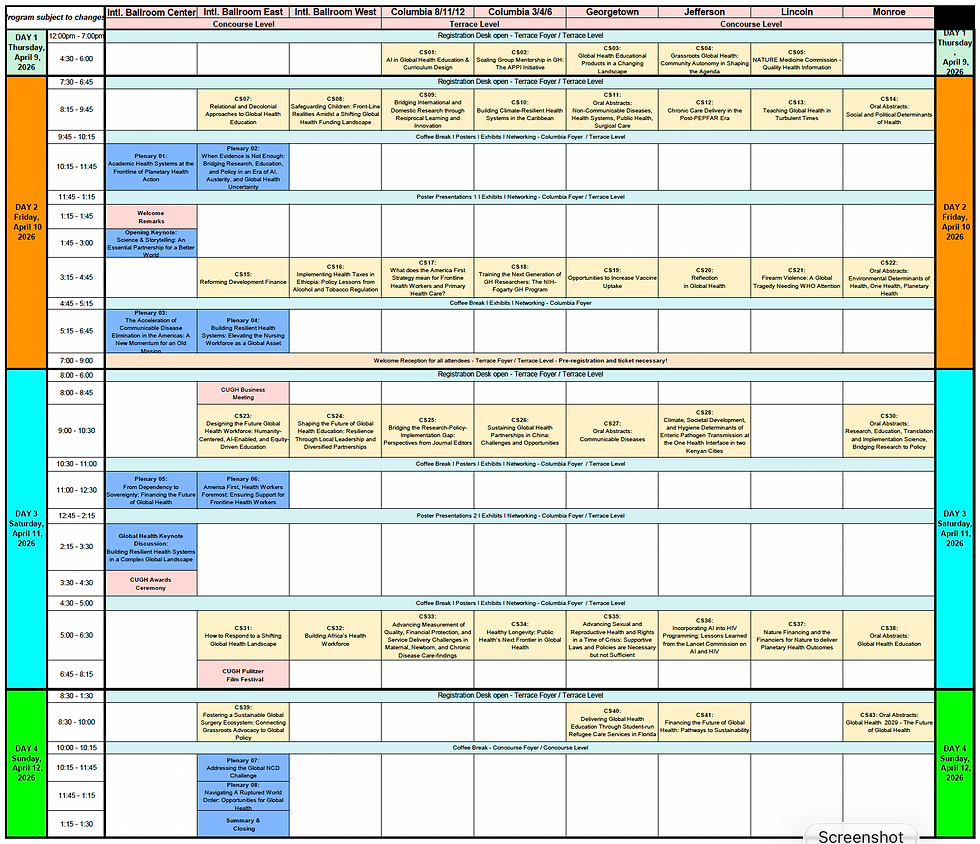

Confirmed panels include:
-
AI in Global Health Education & Curriculum Design
-
Scaling Group Mentorship in Global Health: Lessons from the APPI Initiative
-
Global Health Educational Products in a Changing Landscape
-
Grassroots Global Health: Community Autonomy in Shaping the Agenda
-
Challenges and Opportunities in our Evolving Global Health Landscape: Engagement with the NATURE Medicines Commission on Quality Health Information for All
-
Beyond Extractive Learning: Relational and Decolonial Approaches to Global Health Education
-
Safeguarding Children: Front-Line Realities Amidst a Shifting Global Health Funding Landscape
-
Taking the Global View: Bridging International and Domestic Research through Reciprocal Learning and Innovation
-
Building Climate-Resilient Health Systems in the Caribbean
-
Integration at a Crossroads: Chronic Care Delivery in the Post-PEPFAR Era
-
Teaching Global Health in Turbulent Times: Challenges, Innovations, and the Fight for Equity
-
Reforming Development Finance: From Aid Dependence to Sustainable Impact
-
Perils at the Frontline: What does the America First Strategy mean for Frontline Health Workers and Primary Health Care?
-
Training the Next Generation of Global Health Researchers: The NIH-Fogarty Global Health Program for Fellows and Scholars / Launching Future Leaders in Global Health Research Training Program (LAUNCH)
-
Firearm Violence: A Global Tragedy Needing WHO Attention
-
Designing the Future Global Health Workforce: Humanity-Centered, AI-Enabled, and Equity-Driven Education
-
Shaping the Future of Global Health Education: Resilience Through Local Leadership and Diversified Partnerships
-
Sustaining Global Health Partnerships in China: Challenges and Opportunities
-
Climate, Societal Development, and Hygiene Determinants of Enteric Pathogen Transmission at the One Health Interface in two Kenyan Cities: Evidence from the PATHOME Study
-
How to Respond to a Shifting Global Health Landscape
-
Building Africa’s Health Workforce: Driving Change Through Partnerships and Innovations in Health Professions Education
-
Beyond Access: Advancing Measurement of Quality, Financial Protection, and Service Delivery Challenges in Maternal, Newborn, and Chronic Disease Care-Findings from the QuEST Network eCohorts
-
Healthy Longevity: Public Health’s Next Frontier in Global Health
-
Advancing Sexual and Reproductive Health and Rights in a Time of Crisis: Supportive Laws and Policies are Necessary but Not Sufficient
-
Incorporating AI into HIV programming: Lessons Learned from the Lancet Commission on AI and HIV
-
Nature Financing and the Financiers for Nature to Deliver Planetary Health Outcomes
-
Fostering a Sustainable Global Surgery Ecosystem: Connecting Grassroots Advocacy to Global Policy
-
Global Health at Home: Delivering Global Health Education Through Student-run Refugee Care Services in Florida
-
Financing the Future of Global Health: Pathways to Sustainability
Public Health & Prevention
Primary & Surgical Care
Emergency Care & Nursing
Health Human Resources
Cancer & Mental Health
Cardiovascular & Respiratory Diseases
Diabetes, Trauma & Accidents
Maternal, Sexual & Reproductive Health
Child & Adolescent Health
Disabilities & Oral Health
Pharmacology
Water, Sanitation & Hygiene
Environmental Drivers
Nutrition & Food Security
Good Governance
Education Governance
Strengthening Public Institutions
Preventing Corruption & Illicit Money Flows
Disinformation-Misinformation
Capacity Building
Reforming Financing for Development
International Law
Press Freedom
Diplomacy
International Regulations & International Cooperation
Displacement & Migration
Conflict Prevention & Post Conflict Reconciliation
Trade Agreements
Accountability
Corporate Social Responsibility
Economic stability
Human Rights
Decolonizing global health
Conflict prevention
Emergency Response and Preparedness Capacity
Housing & the Built Environment
Water, Sanitation & Hygiene
Independent, free media
Community Safety
Gender Based Violence
Racism & Discrimination
Gender Equity
Human Trafficking
Digital Divide
Climate Change
Biodiversity Crisis
Protecting ecosystem services
Pollution
One Health
Environmental Health
Planetary Health
Architecture
Veterinary Sciences
Animal Health
Water
Healthy Cities and Urban Planning
Protecting Ecosystem Services
Agriculture, fisheries & food security
Deforestation
Ocean Health
Pandemic Prevention & Response
Global Health Security Agenda
Diagnostics & Lab Sciences
HIV/AIDS
Malaria
Polio
NTDs
Tuberculosis Measles, Mumps, Rubella
Hepatitis
Zoonoses
Food-borne Diseases
Animal Health
Vaccine Development
Antimicrobial Resistance
Pharmacology
Policy Making
Capacity Building & Human Resources
Bridging the research-policy-implementation gap
Reasearch
Pedagogy
AI & Machine Learning
Strengthening Management
Translational Research
Reforming Academia
Supply Chain Strengthening
Research Funding & Reform
Monitoring & Evaluation
Overcoming the Digital Divide
Social Sciences & Cultural Competencies
Communication & Leadership Development
Big Data
Innovations & Technology
Reforming global health education
Reforming academia- fits for purpose in the 21st century
Reforming Research
Reforming financing for development
Capacity building
Equitable partnerships in development
Reforming UN agencies, WHO, other INGOs
AI and the potential to revolutionize global health
Cross-sectoral partnerships
Free pre-conference workshops (April 9, 2026)
Pulitzer Center workshop on global health communication